Lebanon’s President Calls for Direct Talks With Israel as War With Hezbollah Displaces Hundreds of Thousands
Lebanon Seeks Negotiations to End Escalating Conflict
The President of Lebanon, Joseph Aoun, has called for direct negotiations with Israel as part of a plan aimed at ending the escalating conflict involving Hezbollah.
According to a spokesperson for the Lebanese president, the country is open to negotiations but cannot begin talks while Israeli airstrikes continue across Lebanese territory.
The proposal was presented during a virtual meeting with senior officials from the European Union, where Aoun outlined what he described as a roadmap toward “permanent security and stability arrangements” along Lebanon’s border with Israel.

So far, Israeli officials have shown little indication that they are ready to enter negotiations, and the government has not immediately responded to the proposal.
A Four-Point Plan for Peace
Under Aoun’s proposal, a complete ceasefire would be implemented alongside the disarmament of Hezbollah. The plan also calls for international support to strengthen the Lebanese Armed Forces, enabling them to regain control over areas affected by the conflict.
The plan further suggests that Lebanon and Israel should begin direct negotiations under international supervision to ensure the successful implementation of these security arrangements.

War Taking Heavy Toll on Lebanon
President Aoun warned that the ongoing war has caused severe humanitarian consequences for Lebanon.
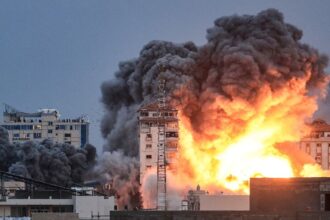
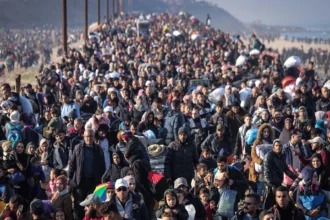
According to the United Nations, more than 700,000 people have been displaced, including 200,000 children, as Israeli airstrikes continue across the country.
Hundreds of civilians have also been killed in the past nine days of strikes.
Many displaced families are reportedly living without proper shelter or basic necessities. Aoun described the situation as devastating, noting that thousands of people have been forced to sleep in the streets after fleeing their homes.
President Criticises Hezbollah
In unusually direct remarks, Aoun strongly criticized Hezbollah, accusing the group of dragging Lebanon into a wider regional war.
Referring to Hezbollah as an “armed faction,” the president said the group had ignored Lebanon’s national interests and the safety of its citizens, warning that its actions risk pushing the country toward instability and chaos.
The criticism follows the Lebanese government’s recent declaration that Hezbollah’s military operations are illegal, although authorities acknowledge that the state currently lacks the capacity to disarm the group independently.
Israel Demands Hezbollah Disarmament
Meanwhile, Benjamin Netanyahu has called on the Lebanese government to take responsibility for enforcing a ceasefire agreement and disarming Hezbollah.
In a message posted on social media, Netanyahu said it was Lebanon’s duty to enforce the agreement and prevent Hezbollah from continuing military operations.
Israel’s ambassador to France, Joshua Zarka, also stated that Beirut had not yet taken meaningful steps toward disarming the militant group.
Ceasefire Agreement Struggling to Hold
Although a ceasefire agreement was reached between Israel and Lebanon in November 2024, with mediation from the United States and France, the agreement has largely failed to hold.
Israel has continued near-daily airstrikes in Lebanon, accusing Hezbollah of attempting to rebuild its military strength.
The conflict intensified further after Hezbollah launched rockets and drones into northern Israel shortly after the start of the U.S.–Israeli attacks on Iran.
Hezbollah said the strikes were retaliation for the killing of Ayatollah Ali Khamenei and ongoing Israeli attacks in the region.
Civilians Caught in the Crossfire
For civilians living in conflict zones, the renewed violence has created fear and uncertainty.
Ahmed al-Halabi, a father of two from the Dahieh district of southern Beirut, said his family fled their home in the middle of the night as missiles struck nearby.
“We were running away from the bombing. There’s no safety,” he said, explaining that he now lives with his family in a school that has been converted into a temporary shelter.
Al-Halabi added that his children have already experienced displacement before and are now suffering psychological trauma from repeated exposure to conflict.
Rising Fears of a Wider War
As fighting continues, analysts warn that the situation could escalate into a broader regional conflict if diplomatic efforts fail.
For now, Lebanon’s leadership is pushing for negotiations and international mediation, hoping to prevent further destruction and restore stability along its volatile southern border.